Best value
RUG-4-GPX
Sony CXD5610 · GPX-1.
- 2 cm RTK
- 10 Hz Output
- Notch filter Anti-jam
$3,500View
Dev kit$3,750

RUG-4 family · Rugged INS
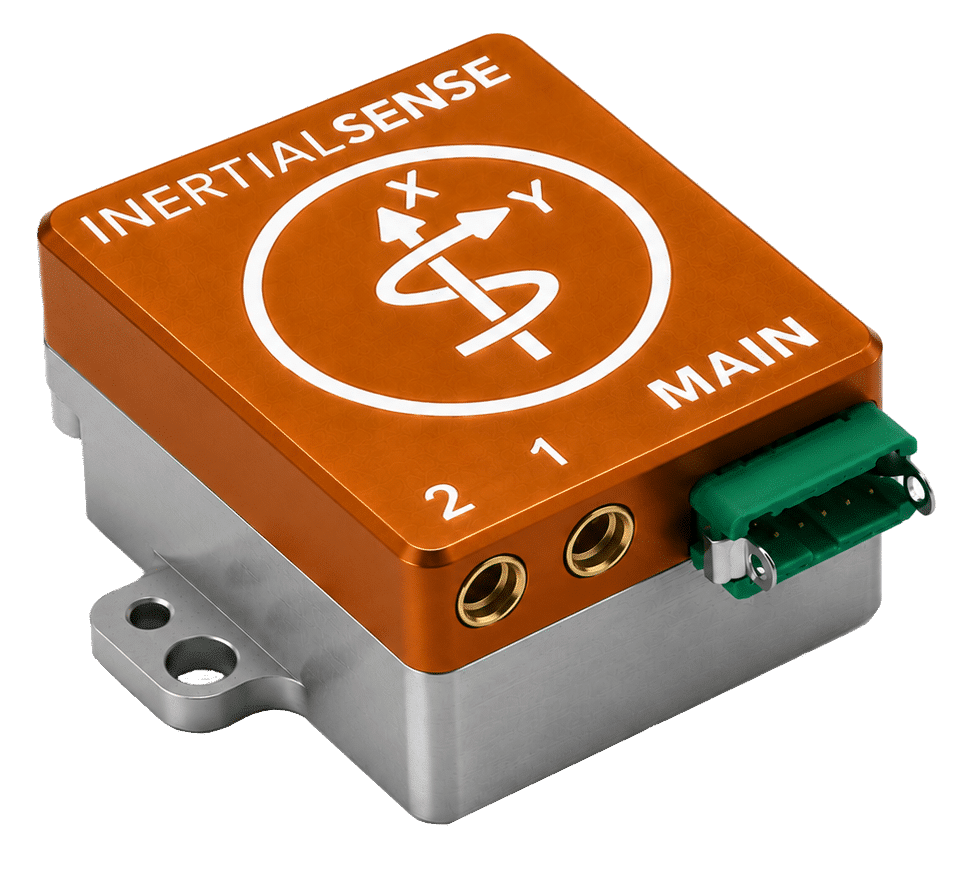
Every RUG-4 shares the same rugged aluminium enclosure, the same IMX-6 tactical-grade IMU, and the same RS232 / RS485 / CAN interfaces. They differ only by GNSS receiver, which determines RTK accuracy, heading precision, update rate and anti-jam protection. This page compares all four side by side.
From $750
Which one?
Same enclosure, IMX-6 IMU and interfaces. Each model has a different GNSS receiver.
Best value
Sony CXD5610 · GPX-1.
Best heading
u-blox ZED-X20D.
Lowest SWaP
Septentrio mosaic-G5 P3H.
Max resilience
Septentrio mosaic-G5 P8.
No GNSS
The RUG-4-G0 is the same rugged housing with the IMX-6 IMU and AHRS fusion, no GNSS receiver fitted.
Overview
The receiver is the only thing that changes between models. The enclosure, the IMX-6 IMU and the interfaces are the same on every RUG-4, so the mounting and wiring stay the same whichever receiver you choose.
| Receiver | Best valueRUG-4-GPX | Best headingRUG-4-X20 | Lowest SWaPRUG-4-G5P3 | Max resilienceRUG-4-G5P8 |
|---|---|---|---|---|
| Receiver overview | ||||
| GNSS chipset | Sony CXD5610 Inertial Sense GPX-1 module | u-blox ZED-X20D X20 platform | Septentrio mosaic-G5 P3H | Septentrio mosaic-G5 P8 |
| RTK / compassing engine | Inertial Sense RTKLib open-source, host-side | Onboard u-blox RTK / PPP-RTK / PPP | Onboard Septentrio GNSS+ RTK engine | Onboard Septentrio GNSS+ RTK engine |
| Antenna configuration | Dual GNSS receivers 2 antennas, standard | Dual antenna all-band on both | Dual antenna heading standard (P3H) | Single chip switchable single/dual antenna |
| Signal & constellation support | ||||
| Frequency bands | Dual-band L1 / L5 | All-band L1/L2/L5/L6 + L-band | Triple-band dual-antenna P3H | Multi-band incl. E6 / E5 AltBoc on-module L-band |
| Constellations | GPS/QZSS, Galileo, GLONASS, BeiDou, NavIC, SBAS | GPS, GLONASS, Galileo, BeiDou, QZSS, NavIC, SBAS | GPS, GLONASS, BeiDou, Galileo, QZSS | GPS, GLONASS, BeiDou, Galileo, QZSS, NavIC, SBAS |
| Receiver channels | 62 physical | 1,344-channel | 789 hardware | 789 hardware |
| Positioning & heading | ||||
| Standalone / SBAS accuracy | 1.0 m CEP (w/ SBAS) | 1.2 m standalone 0.6 m SBAS | 1.2 m standalone 0.4 m DGNSS | 1.2 m standalone 0.6 m SBAS · 0.1 m HAS |
| RTK horizontal accuracy | 2 cm CEP * | 0.6 cm + 1 ppm CEP | 0.6 cm + 0.5 ppm RMS | 0.6 cm + 0.5 ppm RMS |
| Heading / compassing accuracy | 0.4° RMS @ 1 m | 0.1° RMS @ 1 m | 0.15° @ 1 m 0.03° @ 5 m | 0.15° @ 1 m 0.03° @ 5 m |
| RTK convergence time | < 10 s | < 7 s RTK < 40 s PPP-RTK | < 7 s | < 7 s |
| Time to first fix (3D) | ~24 s cold start | ~25 s cold start | < 35 s cold start | < 35 s cold start |
| Max output data rate | 10 Hz position 5 Hz heading | 20 Hz position & heading | 20 Hz | 100 Hz position 50 Hz w/ RTK + attitude |
| Security | ||||
| Anti-jam / anti-spoof | 7-channel notch filter (per band) | Root of Trust, secure boot, Galileo OSNMA, jam/spoof detection | AIM+ Advanced detection + auto mitigation, RAIM+ | AIM+ Ultimate max threat protection, authenticated I/O (DTLS) |
| Price | $3,500 | $4,750 | $6,000 | $7,250 |
| Dev kit | $3,750 | $5,000 | $6,250 | $7,500 |
* GPX-1 RTK accuracy is a fixed CEP specification with no published ppm / baseline-distance term, unlike the other three (fixed error + ppm-of-baseline). GPX-1 time-to-fix is vendor-published per fix type (3D, RTK and heading) from cold start; the other vendors publish 3D cold-start time separately from RTK convergence, which is measured once a 3D fix and corrections are already established. The two are not directly comparable on a cold-start basis.
Figures are typical / RMS values taken from each manufacturer's published datasheet, not independent testing.
Describe your platform and our engineers will recommend the right sensor.
Talk to an engineerFull specifications, dimensions and integration guides for every product.
Open the docs